



Medical Review Disclosure
This content has been reviewed for medical accuracy. Always consult a qualified healthcare professional before making any medical decisions. [Last reviewed: 2026-08-12]
If you have been diagnosed with ovarian, breast, prostate, or pancreatic cancer, or if your close relative faces a similar condition, then most probably you have heard the term PARP inhibitors from your medical specialists.
For a very long period of time, chemotherapy was considered the only means for battling tumors since it could destroy actively dividing cells both in cancerous formations and healthy parts of the body.
PARP inhibitors are a much more elegant method that uses the genetic vulnerability of cancer cells to destroy themselves through their damaged DNA.
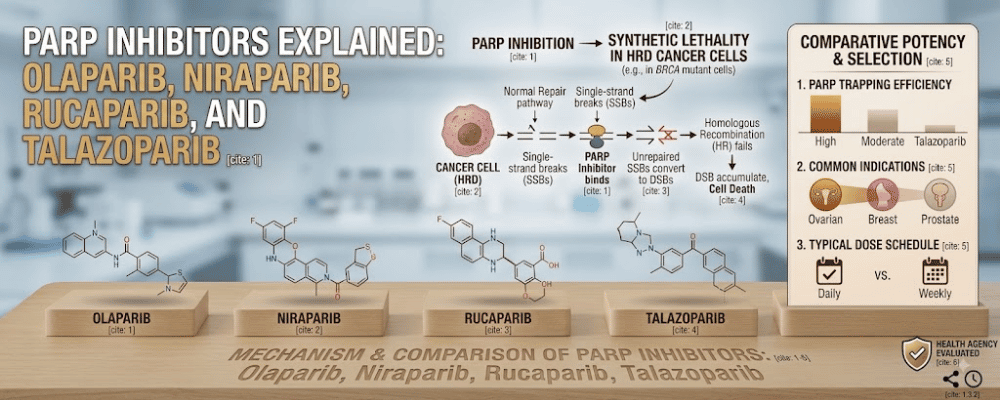
Currently, there are four main PARP inhibitors that are actively used by clinicians, namely, Olaparib, Niraparib, Rucaparib, and Talazoparib. They are all representatives of the same drug group, but they have certain differences in binding to DNA, targetable cancers, and side effects profile.
How PARP Inhibitors Work: The Concept of "Synthetic Lethality"
To understand why PARP inhibitors are so effective, it helps to imagine your cells as having two distinct toolkits for repairing broken DNA:
-
Toolkit 1 (The Single-Strand Repair Crew): Managed by an enzyme called PARP (Poly [ADP-ribose] Polymerase). PARP acts like an emergency roadside crew that quickly fixes small, single-strand nicks in the cell's DNA.
-
Toolkit 2 (The Double-Strand Repair Crew): Managed by genes like BRCA1, BRCA2, and other proteins in a pathway called Homologous Recombination (HR). This crew fixes complex, double-strand breaks in the DNA ladder.
Under normal circumstances, both repair kits will operate just fine. In the event that an agent inhibits Repair Kit 1 in a healthy cell, that cell will switch to using Repair Kit 2 (the BRCA pathway) to repair the damaged DNA.
On the other hand, there is usually some genetic defect in BRCA1 or BRCA2, or some other form of repair problem such as HRD (Homologous Recombination Deficiency), which makes cancer cells incapable of using Repair Kit 2.
Now, once the patient has been administered a PARP inhibitor, Repair Kit 1 is inhibited. Healthy cells will survive easily since Repair Kit 2 is working just fine for them.
However, cancer cells, being incapable of utilizing both repair kits, will have large amounts of irreparable DNA damage in them every time they try to divide. And since DNA damage is irreparable, the cancer cell will commit suicide.
This is referred to as synthetic lethality in the field of oncology.
Meet the Four Key PARP Inhibitors
While all four drugs block the PARP enzyme, they differ in clinical indications, dosing schedules, and unique characteristics.
1. Olaparib (Lynparza)
Olaparib was the first drug in the group to receive FDA approval. Therefore, it is the inhibitor that has the largest spectrum of approved indications due to the long time on the market.
- Indications for Approval: Ovarian cancer (both first-line maintenance treatment and recurrent disease), HER2-negative germline BRCA mutated metastatic breast cancer, mCRPC, and germline BRCA-mutated metastatic pancreatic cancer.
- Dosage Regimen: Oral tablet, administered twice a day (generally at a dose of 300 mg twice a day).
- Unique Feature: First targeted agent to demonstrate significant survival advantage in the maintenance treatment of germline BRCA-mutated pancreatic cancer.
2. Niraparib (Zejula)
The main reason why niraparib has changed the way of treating advanced ovarian cancers is the clinical flexibility associated with the presence or absence of the patient’s genetic profile.
- Indications for Use: Mainly ovarian, fallopian tube, or primary peritoneal cancer (as first-line maintenance treatment following platinum-based response and in cases of recurrence).
- Recommended Dosage: Capsules or tablets to be taken orally once daily (doses vary from 200 to 300 mg once daily).
- Distinctive Characteristic: Niraparib is the first PARP inhibitor that received approval for first-line use in maintenance therapy of ovarian cancer irrespective of BRCA mutation or HRD state in the patients.
3. Rucaparib (Rubraca)
Yet another powerful agent that is predominantly directed towards the management of gynecologic and prostatic cancers is Rucaparib.
- Approved indications: Maintenance therapy for recurrent epithelial ovarian, fallopian tube, or primary peritoneal cancers as well as BRCA mutant mCRPC (metastatic Castrate-Resistant Prostate Cancer).
- Standard dose: Tablets taken twice orally per day (600 mg twice daily).
- Key distinguishing feature: In addition to germline BRCA mutations, Rucaparib has been found to be effective against somatic BRCA mutations. This means that mutations that occurred within the tumor tissue and are not inherited from the parents.
4. Talazoparib (Talzenna)
Talazoparib has a slightly different molecular structure than its relatives. In laboratory tests, it is characterized as a super-strong "PARP trapper."
- Indications for Use: Locally advanced or metastatic HER2-negative germline BRCA mutant breast cancer, as well as metastatic castration-resistant HRR mutant prostate cancer, in combination with enzalutamide.
- Usual Dosage: Taken orally as capsules once a day in a much smaller amount by weight (usually 1 mg or 0.35 mg once daily) because of its high potency.
- Unique Attribute: PARP trapping involves not only inhibition of the enzyme but pinning it on the DNA strand as a barricade. This causes the crash of the replication system in the cell. Talazoparib is regarded as the most potent PARP trapper in the group of medications.
Head-to-Head Comparison Matrix
| Drug Name (Brand) | Primary Clinical Focus | Typical Dosing Schedule | Notable Feature |
| Olaparib (Lynparza) | Ovarian, Breast, Prostate, Pancreatic | Oral / Twice Daily | Broadest range of cancer approvals |
| Niraparib (Zejula) | Ovarian Cancer | Oral / Once Daily | Approved in ovarian maintenance regardless of BRCA status |
| Rucaparib (Rubraca) | Ovarian, Prostate | Oral / Twice Daily | Strong efficacy in both inherited and tumor-only mutations |
| Talazoparib (Talzenna) | Breast, Prostate | Oral / Once Daily | Highest "PARP trapping" potency at low mg doses |
What to Expect: Side Effects and Management
Because PARP inhibitors are taken as pills at home, many patients find them far more manageable than conventional intravenous chemotherapy.
However, "targeted" does not mean completely side-effect-free. Because healthy bone marrow cells divide rapidly, PARP inhibitors share a few common, manageable toxicities:
1. Hematologic Effects (Low Blood Counts)
- Anemia (Low RBCs): Fatigue and shortness of breath. These are seen in all PARP inhibitors.
- Thrombocytopenia (Low Platelets): Bleeding tendency. Fact: Niraparib has a somewhat higher risk of early reduction in platelets, which is why a weight and platelet-based initial dose of 200 mg rather than 300 mg is used by physicians.
- Neutropenia (Low WBCs): Predisposition to infections.
2. Gastrointestinal Changes
-
Mild to moderate nausea, altered taste, loss of appetite, and fatigue often occur during the first few weeks of starting treatment. Oncologists typically prescribe mild anti-nausea medications to help patients adjust during the first month.
3. Rare, Serious Risks
- MDS/AML: A very low number of individuals (typically less than 1.5% to 2%) develop myelodysplastic syndrome or acute myeloid leukemia due to chronic treatment with PARP inhibitors or heavy use of chemotherapy drugs before. Monthly monitoring of complete blood counts is essential.
The Bottom Line: Why Biomarker Testing Matters
The history of PARP inhibitors provides us with an important insight into today's medicine: the genotype of the tumor is equally important as the primary site of origin.
If you were diagnosed with ovarian, breast, prostate or pancreatic cancer, make sure to advocate for yourself and talk to your healthcare providers about the possibility of undergoing biomarker testing, including germline genetic testing and HRD testing in tumor tissue.
Your knowledge about the status of your BRCA and HRD is the key to your PARP inhibitor treatment.
References
-
PubMed Central (PMC): PARP Inhibitors in Cancer Therapy: Magic Bullets but High Resistance (PMC8073512)
-
PubMed Central (PMC): The Evolving Landscape of PARP Inhibitors in Oncology (PMC7520743)
-
ecancer Medical Science: PARP Inhibitors: Similarities, Differences, and Clinical Applications Video Analysis
-
National Cancer Institute (NCI): PARP Inhibitor Targeted Therapy Overview
Related: View all breast cancer medications
Dr. Sophie Reynolds
Last reviewed: 2026-08-12