



Medical Review Disclosure
This content has been reviewed for medical accuracy. Always consult a qualified healthcare professional before making any medical decisions. [Last reviewed: 2026-06-15]
Treatment for advanced cancer has come a long way from what was available in the past. For many years now, the major cancer treatments available were chemotherapy and radiation aimed at preventing further tumor growth.
Today, a group of biological medications known as immune checkpoint inhibitors has taken center stage in the oncology arena.
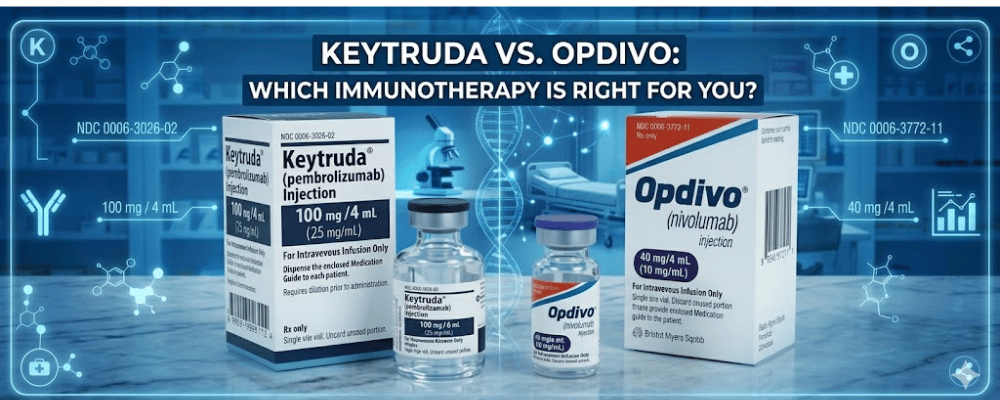
Leading this medical breakthrough are two popular immuno-oncology drugs: Keytruda (pembrolizumab), which is made by Merck Sharp & Dohme, and Opdivo (nivolumab), created by Bristol Myers Squibb.
Due to the fact that both medicines are used in the treatment of similar advanced cancers, people always wonder: what is the difference between Keytruda vs. Opdivo? Although there are some basic similarities between the two drugs, the following aspects make them unique: clinical applications under FDA approval, dosing interval, and cost considerations.
The Core Science: Do They Work the Same Way?
From a molecular perspective, the answer is affirmative. The two drugs in question – Keytruda and Opdivo – are both humanized monoclonal antibodies of the same pharmacological class: PD-1 inhibitors.
The PD-1 Pathway Blockade
In order to comprehend the similar modes of operation of both treatments, one should first see how the immune system is a complex network of balance.
The way your body identifies and kills abnormal cells using its T-cells is one such way.
Normal cells have a ligand, a protein, that goes by the names of PD-L1 or PD-L2. This PD-1 ligand binds to the PD-1 receptor on T-cells. In turn, this sends a "turn off" message and acts like a biological break.
Sadly, however, many complex tumors exploit this defensive response. The cancer cells generate excessive PD-L1 and essentially become invisible to the body’s immune system.
They shut down any surrounding T-cells and continue to grow unchecked and undetected.
Releasing the Brakes on T-Cells
Keytruda and Opdivo both work as highly selective barriers. The process begins once both medicines attach to the PD-1 receptor found on a patient's lymphocytes.
This ensures that the cancer cells will not be able to establish any contact with the T-cell.
This means that both medicines prevent the cell from utilizing its evasive technique and release the natural biological barriers present within the immune system.
The end result of this is that the T-cell becomes active and destroys any cancer cell present in the body.
Even though these two medicines have similar primary mechanisms, the clinical trials and molecular compositions of both are slightly different.
Head-to-Head Comparison: Key Clinical Differences
While the underlying science is identical, Keytruda and Opdivo diverge noticeably when looking at their approved indications and how they are administered in specialty cancer clinics.
1. FDA-Approved Clinical Uses
Doctors rarely take into consideration their personal preferences when making decisions about choosing one or another of these agents but always base their decision only on the results of clinical trials for particular tumor types.
- Keytruda (Pembrolizumab): Keytruda enjoys undisputed leadership on the market in the treatment of non-small cell lung cancer. It is widely used as a first-line therapy, alone for PD-L1-high tumors or in combination with platinum doublet chemotherapy. Besides, Keytruda possesses historic "tissue-agnostic" approvals. Thus, it can be used for the treatment of solid tumors anywhere in the body that have genetic biomarkers characteristic of MSI-H or dMMR diseases.
- Opdivo (Nivolumab): Apart from being applied in the treatment of non-small cell lung cancer and advanced melanoma, Opdivo has achieved particular clinical leadership in some other diseases. In particular, it enjoys popularity in renal cell carcinoma, advanced gastric cancer, and esophageal cancer. Moreover, its clinical application often involves the use of a combination of Opdivo and another immune checkpoint inhibitor, Yervoy (Ipilimumab), in treating difficult cases.
2. Administration and Dosing Intervals
Both drugs are administered exclusively via a slow intravenous (IV) infusion over approximately 30 minutes in an ambulatory infusion center or specialty hospital. However, their adult fixed-dosing schedules vary:
- Keytruda Dosing: Features a highly convenient extended fixed regimen. Adults typically receive either 200 mg every 3 weeks or a double dose of 400 mg every 6 weeks.
- Opdivo Dosing: Generally follows an alternative clinical schedule. The standard adult fixed options are 240 mg every 2 weeks or an extended 480 mg every 4 weeks.
Core Comparison Matrix
Feature | Keytruda (Pembrolizumab) | Opdivo (Nivolumab) |
Manufacturer | Merck Sharp & Dohme (MSD) | Bristol Myers Squibb (BMS) |
Drug Classification | Humanized IgG4 Monoclonal Antibody | Humanized IgG4 Monoclonal Antibody |
Primary Target | PD-1 Receptor Blockade | PD-1 Receptor Blockade |
Standard Adult Schedules | 200 mg every 3 weeks OR 400 mg every 6 weeks | 240 mg every 2 weeks OR 480 mg every 4 weeks |
Infusion Duration | ~30 Minutes via IV | ~30 Minutes via IV |
Major Monotherapy Strengths | First-line Lung Cancer (NSCLC), MSI-H/dMMR tumors | Adjuvant Melanoma, Refractory Hodgkin Lymphoma |
Common Combination Setup | Paired with traditional chemotherapy | Paired with Yervoy (CTLA-4 inhibitor) |
Cost, Access, and Financial Considerations
The two drugs are advanced biological drugs, and hence there is a great cost implication involved in taking the two drugs.
There is no telling just how much the difference in pricing between the two drugs will be because of individual insurance plans, formularies at hospitals, and location factors.
The Global Cost Landscape
While the two drugs have been priced at several thousand dollars in the Western market for a single standard dosage, thus placing the cost of the treatment program per annum close to or above $150,000, depending on individual insurance plans and co-pay card assistance programs.
Regional Spotlight: Keytruda vs. Opdivo Philippines
In developing pharmaceutical markets like the Philippines, navigating the choice between these two immunotherapies involves balancing clinical efficacy with local logistics and financial planning.
- Availability: Both drugs are widely accessible in the major private as well as government cancer centers in Metro Manila (Philippine General Hospital, St. Luke’s Medical Center, The Medical City), as well as other regional hospitals.
- Pricing Context: In the Philippines, prices of an individual vial of immunotherapy can vary considerably from about ₱70,000 to more than ₱150,000 per vial based on dosage requirements (for example, whether the dosage will be 100 mg or 200 mg).
Due to the availability of 6-week dosing with 400 mg in Keytruda and 4-week dosing with 480 mg in Opdivo, it is important to consider the price per month rather than the price of a single vial. - Supporting Organizations: HMOs of the standard kind in the Philippines generally offer lower maximums on reimbursement of biologics.
Patients and their families in the Philippines usually collaborate with social workers in hospitals in applying for the PhilHealth Z-Benefit Package for selected cancers. Many patients avail of compassionate use or access programs organized directly by Merck or Bristol Myers Squibb.
Side Effect Profiles: Are They Identical?
Since both drugs act on precisely the same pathway, they have very similar side effect profiles. As opposed to conventional chemotherapy, these drugs will not typically lead to general hair loss and bone marrow suppression.
Common, Manageable Side Effects
The majority of patients on either therapy experience mild to moderate side effects, which include:
- Generalized fatigue and physical weakness
- Mild skin rash or dry, itchy skin (pruritus)
- Nausea, decreased appetite, and temporary weight loss
- Mild diarrhea or musculoskeletal joint pain
Serious Immune-Mediated Adverse Reactions (irAEs)
The main risk involved with both Keytruda and Opdivo is that an overly active immune response can identify normal tissues within the body as being malignant tumors.
The effects of these system-wide side effects can impact any system and require immediate medical care:
- Pneumonitis: Inflammation of the lungs characterized by a dry cough and breathing difficulties.
- Colitis: Severe inflammation of the colon resulting in diarrhea and abdominal cramping.
- Endocrine Disorders: Inflammation of either the thyroid gland or pituitary gland.
In cases where serious side effects arise, the approach to treatment for both medications is the same, which includes discontinuing the medication and prescribing corticosteroid therapy at high doses.
Which One Is Right For You?
Choosing between Keytruda and Opdivo is hardly a patient preference-based decision process. It is more likely that your inter-professional oncology healthcare provider will make recommendations for an appropriate medication based on the following four vital criteria:
- Specific Type of Cancer and Its Staging: Depending on the location of your tumor, you are more likely to have a statistical advantage to one drug over the other or particular combination treatments.
- Pathological Biomarkers Analysis: A tumor biopsy analysis will be conducted by your physician to determine your unique PD-L1 expression percentage (TPS) or MSI-H/dMMR marker.
- Patient Dosage Preferences: A patient might have a preference for taking Keytruda on a 6-week dosage schedule compared to the 2-4 week cycle for Opdivo.
- Formulary Accessibility and Financing: Availability at your local hospital, insurance coverage, or patient assistance program eligibility could become a tiebreaker in the end.
Frequently Asked Questions (FAQ)
1. Can you switch from Opdivo to Keytruda if one stops working?
However, if there is direct drug resistance to Opdivo, then the changeover from Opdivo to Keytruda may not be very effective because both these drugs operate using the same biological mechanism by blocking the PD-1 receptor. Your physician may change the course of action to use another type of immunotherapy altogether.
2. Is Keytruda more effective than Opdivo?
Neither drug is universally "better" than the other. Clinical data shows that while Keytruda frequently outperforms Opdivo in first-line non-small-cell lung cancer, Opdivo shows exceptional success when paired with Yervoy for specific kidney and colorectal cancers.
3. How long does a typical treatment course last?
For advanced or metastatic stages, if the cancer remains stable and side effects are well-managed, patients typically continue immunotherapy for up to a maximum of 24 months (2 years).
References
- Science.org Analogs: The Clinical PD-1 Race Analysis
- Moffitt Cancer Center: Immunotherapy FAQ: Understanding Keytruda and Opdivo
- Medical News Today Reference: Pharmacological Differences: Opdivo vs. Keytruda
- GoodRx Clinical Comparison: PD-1 and PD-L1 Inhibitor Classes & Cost Matrix
- Pharmaceutical Technology Review: A Decade in Review of Blockbuster Immunotherapies
Related: View all diagnosis and detection medications
Dr. Sophie Reynolds
Last reviewed: 2026-06-15