



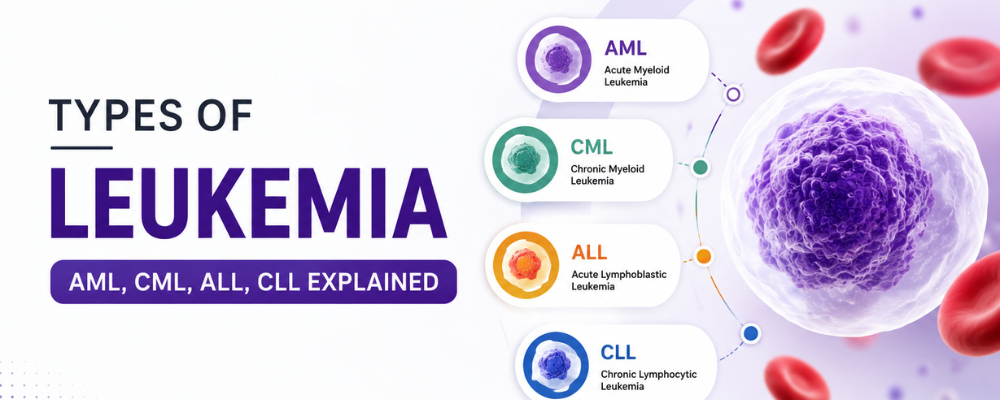
Leukemia is a type of cancer that affects the blood and bone marrow, also known as blood cancer, disrupting the body’s ability to produce healthy blood cells. Unlike many other cancers that form solid tumors, leukemia begins in the cells that produce blood and causes abnormal white blood cells to grow uncontrollably.
These abnormal cells interfere with the production of healthy:
- Red blood cells (carry oxygen)
- White blood cells (fight infection)
- Platelets (help blood clot)
Leukemia is not a single disease. It includes several types, each with different causes, progression rates, symptoms, and treatment approaches. The four major forms are:
- Acute Myeloid Leukemia (AML)
- Chronic Myeloid Leukemia (CML)
- Acute Lymphocytic Leukemia (ALL)
- Chronic Lymphocytic Leukemia (CLL)
Understanding these types is important because treatment and prognosis vary significantly between them.
What Happens in Leukemia?
To understand leukemia, it helps to know how healthy blood cells are made.
Inside the bone marrow are immature stem cells that develop into:
- Red blood cells
- White blood cells
- Platelets
In leukemia, genetic mutations cause immature white blood cells to:
- Grow uncontrollably
- Fail to mature properly
- Crowd out healthy blood cells
As these abnormal cells accumulate, the body struggles to:
- Fight infections
- Carry oxygen
- Prevent bleeding
This leads to many of the symptoms associated with leukemia.
How Leukemia Is Classified
Leukemia is classified based on:
1. How Quickly It Progresses
Acute Leukemia
- Develops rapidly
- Involves immature blood cells (blasts)
- Symptoms appear suddenly
- Requires immediate treatment
Chronic Leukemia
- Develops slowly over time
- Involves more mature blood cells
- Symptoms may develop gradually
- Sometimes detected during routine tests
2. The Type of Blood Cell Affected
Myeloid Leukemia
Affects myeloid stem cells that normally develop into:
- Red blood cells
- Platelets
- Certain white blood cells
Lymphocytic (Lymphoblastic) Leukemia
Affects lymphoid cells that become:
- B-cells
- T-cells
These classifications create the four major leukemia types:
- AML
- CML
- ALL
- CLL
1. Acute Myeloid Leukemia (AML)
What Is AML?
Acute Myeloid Leukemia (AML) is a rapidly progressing cancer that affects the myeloid cells in the bone marrow. It occurs when immature myeloid cells called myeloblasts fail to mature properly and begin multiplying uncontrollably.
AML is one of the most common acute leukemias in adults, though it can occur at any age.
How AML Develops
Normally, myeloid stem cells mature into healthy:
- Red blood cells
- Platelets
- Infection-fighting white blood cells
In AML:
- Myeloblasts stop maturing
- Abnormal cells accumulate rapidly
- Bone marrow becomes overcrowded
This prevents the production of healthy blood cells and leads to serious complications.
Symptoms of AML
AML symptoms often develop quickly over days or weeks.
Severe fatigue and weakness
Fever and frequent infections
Easy bruising and bleeding
Shortness of breath
Pale skin
Bone and joint pain
Advanced Symptoms:
Swollen gums
Enlarged spleen or liver
Weight loss
Because AML progresses rapidly, early diagnosis is extremely important.
Risk Factors for AML
Several factors may increase the risk:
- Older age
- Smoking
- Radiation exposure
- Exposure to benzene
- Previous chemotherapy
- Certain genetic disorders
AML Subtypes and Molecular Mutations
AML is not a single disease. It includes several subtypes based on genetic changes.
Important Mutations:
- FLT3 mutation
- IDH1/IDH2 mutation
- NPM1 mutation
These mutations help guide targeted treatment decisions.
Treatment Options for AML
Treatment often involves intensive therapy.
Common Treatments:
- Chemotherapy
- Targeted therapy
- Stem cell transplant
- Immunotherapy
Targeted Therapy Examples:
- Midostaurin (FLT3 inhibitor)
- Ivosidenib (IDH1 inhibitor)
Prognosis of AML
AML can be life-threatening if untreated. However, survival rates are improving due to:
- Earlier diagnosis
- Molecular testing
- Precision medicine
2. Chronic Myeloid Leukemia (CML)
What Is CML?
Chronic Myeloid Leukemia (CML) is a slow-growing leukemia that affects myeloid cells. It is strongly associated with a genetic abnormality called the Philadelphia chromosome.
This chromosome creates the BCR-ABL fusion gene, which produces an abnormal protein that causes uncontrolled cell growth.
Phases of CML
CML develops in three phases:
1. Chronic Phase
- Most patients are diagnosed here
- Mild or no symptoms
- Best response to treatment
2. Accelerated Phase
- Increased abnormal cells
- Symptoms worsen
3. Blast Crisis
- Aggressive stage resembling acute leukemia
- Difficult to treat
Symptoms of CML
Symptoms often appear gradually.
Common Symptoms:
- Fatigue
- Weight loss
- Night sweats
- Enlarged spleen
- Feeling full quickly
Some patients are diagnosed during routine blood tests before symptoms appear.
Targeted Therapy Revolution in CML
CML treatment changed dramatically with the introduction of tyrosine kinase inhibitors (TKIs).
How TKIs Work:
They block the BCR-ABL protein responsible for cancer growth.
Common TKIs:
These therapies transformed CML from a fatal disease into a manageable chronic condition for many patients.
3. Acute Lymphocytic Leukemia (ALL)
What Is ALL?
Acute Lymphocytic Leukemia (ALL) is a rapidly growing leukemia affecting immature lymphoid cells called lymphoblasts.
It is the most common cancer in children, but can also affect adults.
How ALL Develops
In ALL:
- Lymphoblasts multiply rapidly
- Healthy blood cells decrease
- Cancer cells spread through the blood and the bone marrow
Without treatment, ALL progresses quickly.
Symptoms of ALL
Symptoms often develop suddenly.
Common Symptoms:
- Fever
- Fatigue
- Frequent infections
- Bone and joint pain
- Bleeding or bruising
- Swollen lymph nodes
Children may also experience:
- Irritability
- Loss of appetite
- Difficulty walking due to bone pain
Advanced and Targeted Therapies in ALL
Treatment is often divided into:
- Induction phase
- Consolidation phase
- Maintenance phase
Modern Therapies Include:
- CAR T-cell therapy
- Monoclonal antibodies
- Targeted therapy for Philadelphia chromosome-positive ALL
4. Chronic Lymphocytic Leukemia (CLL)
What Is CLL?
Chronic Lymphocytic Leukemia (CLL) is a slow-growing leukemia that affects mature B-lymphocytes.
It is the most common leukemia in adults, particularly older adults.
How CLL Progresses
CLL develops gradually:
- Abnormal lymphocytes accumulate slowly
- Disease may remain stable for years
- Some patients never need immediate treatment
Symptoms of CLL
Early Symptoms:
- Fatigue
- Swollen lymph nodes
- Frequent infections
Advanced Symptoms:
- Weight loss
- Night sweats
- Enlarged spleen
- Anemia
Many people are diagnosed accidentally during routine blood tests.
Modern Treatment Approaches in CLL
Some patients only require monitoring (“watch and wait”).
Treatment Options:
- Targeted therapy
- Immunotherapy
- Chemotherapy
- Stem cell transplant in select cases
Targeted Therapies in CLL
Modern therapies have dramatically improved outcomes.
Important Drug Classes:
- BTK inhibitors
- BCL-2 inhibitors
Examples:
- Ibrutinib
- Acalabrutinib
- Venetoclax
Major Differences Between AML, CML, ALL, and CLL
| Type | Cell Type | Progression | Common Age Group |
|---|---|---|---|
| AML | Myeloid | Acute/Fast | Adults |
| CML | Myeloid | Chronic/Slow | Adults |
| ALL | Lymphoid | Acute/Fast | Children & adults |
| CLL | Lymphoid | Chronic/Slow | Older adults |
How Leukemia Is Diagnosed
Doctors use several tests:
Blood Tests
- Complete blood count (CBC)
- Peripheral blood smear
Bone Marrow Biopsy
Checks for abnormal leukemia cells.
Genetic & Molecular Testing
Identifies mutations and guides treatment.
Imaging Tests
Used in some cases to check organ involvement.
Why Understanding Leukemia Types Is Important
Each leukemia type behaves differently and requires a unique treatment approach.
Understanding the subtype helps doctors:
- Select targeted therapies
- Predict disease progression
- Improve treatment outcomes
Precision medicine and molecular testing are now transforming leukemia care worldwide.
Conclusion
AML, CML, ALL, and CLL are the four major types of leukemia, each with distinct characteristics, symptoms, and treatment strategies. While acute leukemias require urgent treatment, chronic leukemias may progress slowly over many years.
Advances in targeted therapy, immunotherapy, and stem cell transplantation have significantly improved survival rates and quality of life for leukemia patients. Early diagnosis and specialized care remain critical for achieving the best outcomes.
FAQs
1. Which leukemia type is most aggressive?
Acute leukemias (AML and ALL) are generally more aggressive because they progress rapidly.
2. Which leukemia is most common in children?
ALL is the most common leukemia in children.
3. Can leukemia be cured?
Some types, especially ALL in children, can often be cured with treatment.
4. What causes leukemia?
Leukemia is caused by genetic mutations in blood-forming cells.
5. Are targeted therapies effective in leukemia?
Yes, targeted therapies have significantly improved outcomes in diseases like CML and CLL.
References
- Cancer Center – Types of Leukemia
https://www.cancercenter.com/cancer-types/leukemia/types - Leukemia Research Foundation
https://leukemiarf.org/leukemia/ - AACR – Leukemia Overview
https://www.aacr.org/patients-caregivers/cancer/leukemia/ - MedlinePlus – Leukemia
https://medlineplus.gov/leukemia.html - NCBI Bookshelf – Leukemia Overview
https://www.ncbi.nlm.nih.gov/books/NBK560490/